

Dissolved Air Flotation (DAF) vs Sedimentation
DAF vs. Sedimentation: Which Is More Suitable for Wastewater Treatment?
One of the main challenges in wastewater treatment is separating suspended solids, oil, grease, and other contaminants from water.
One of the most commonly used methods is sedimentation, a separation process that uses gravity to make particles settle to the bottom of a tank.
But what happens when the contaminants that need to be removed have a low density, such as oil, grease, algae, or fine particles that are difficult to settle?
This is where Dissolved Air Flotation (DAF) can be used as one of the treatment technologies.
So, is DAF better than sedimentation? The answer is not that simple. Both technologies have different operating principles, advantages, and applications. The selection should be based on the wastewater characteristics and treatment targets.
What Is Sedimentation?
Sedimentation is a process of separating solids from water by utilizing gravity.
Wastewater is fed into a sedimentation tank or clarifier under relatively calm flow conditions. Particles with a higher density than water gradually move downward and settle at the bottom of the tank.
The settled solids are then collected as sludge, while the clarified water flows out from the upper part of the tank.
Sedimentation is widely used in water and wastewater treatment because of its relatively simple operating principle and low energy requirements.
However, the effectiveness of sedimentation depends greatly on the characteristics of the particles being separated.
When Does Sedimentation Have Limitations?
Sedimentation works best when particles or flocs have sufficient size and density to settle.
Problems may occur when wastewater contains:
-
Oil and grease
-
Low-density particles
-
Algae
-
Fine suspended solids
-
Lightweight flocs
-
Contaminants that are difficult to settle
These contaminants may remain suspended in the water or even tend to float on the surface.
Under these conditions, relying solely on gravity may not provide optimal separation performance.
What Is Dissolved Air Flotation (DAF)?
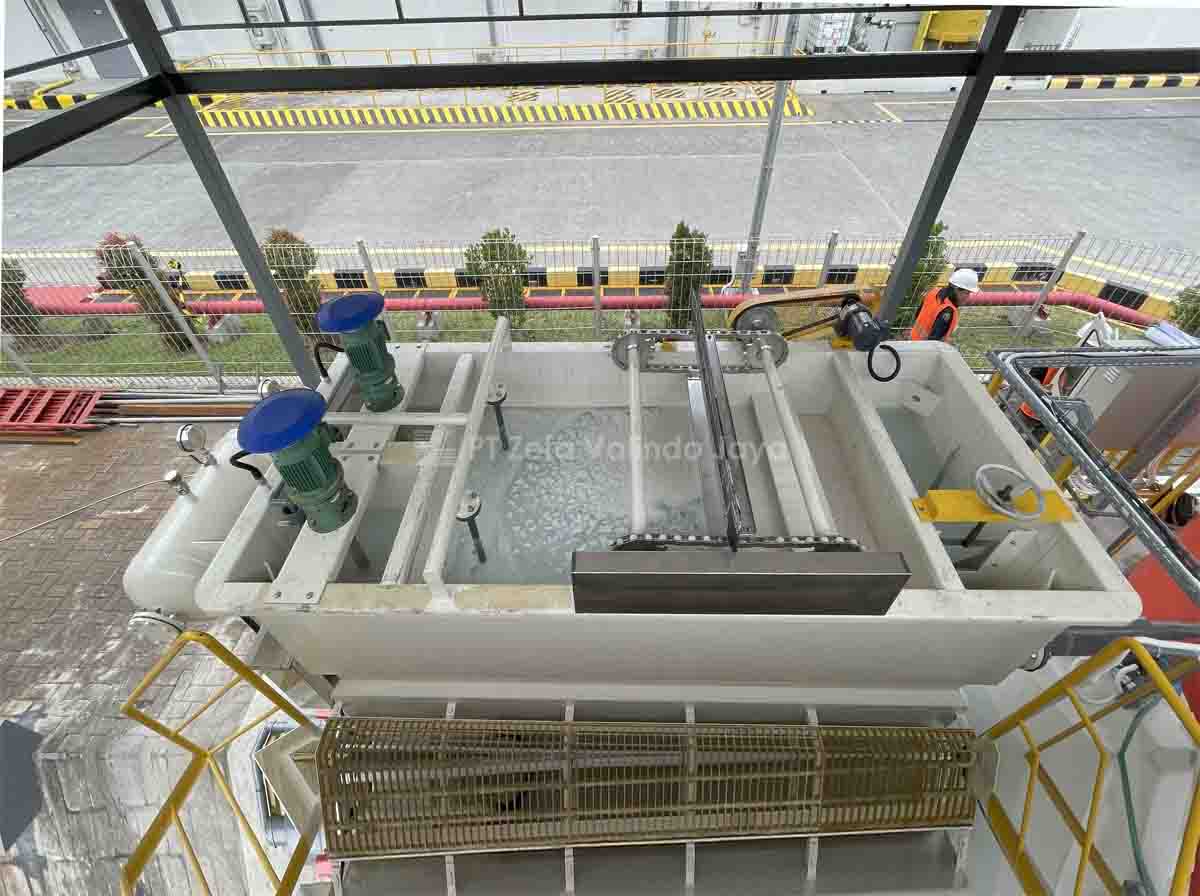
Dissolved Air Flotation (DAF) is a separation technology that uses very small air bubbles (microbubbles) to help lift contaminants to the water surface.
Unlike sedimentation, which uses gravity to make particles settle, DAF uses the principle of flotation or buoyancy to bring contaminants upward.
In a DAF system, a portion of the water is recirculated and pressurized. Air is then dissolved into the pressurized water.
When the pressurized water is released into the flotation tank, the pressure drops and the dissolved air forms microbubbles.
These bubbles attach to suspended solids, oil, grease, and other contaminants. As a result, the particles become more buoyant and are lifted toward the surface.
The floating sludge is then collected using a skimming mechanism or sludge scraper.
DAF vs. Sedimentation: What Is the Difference?
The main difference between DAF (Dissolved Air Flotation) and sedimentation is their separation mechanism. Sedimentation uses gravity to make particles settle, while DAF uses microbubbles to lift particles to the surface.
Sedimentation is generally suitable for heavy and easily settleable solids, while DAF is more suitable for oil, grease, fine suspended solids, and low-density particles that are difficult to separate through conventional sedimentation.
In terms of system design, DAF can also be an option when a faster separation process or a more compact installation is required. However, the selection between DAF and sedimentation should always be based on the wastewater characteristics and treatment targets.
So, Which Is Better: DAF or Sedimentation?
There is no single technology that is always better for every type of wastewater.
Sedimentation is a good choice when wastewater contains relatively heavy solids that can form flocs and settle effectively.
Meanwhile, DAF is more suitable when wastewater contains low-density contaminants, oil, grease, fine suspended solids, or when a faster and more compact separation process is required.
In other words:
DAF and Sedimentation Can Also Be Used Together
DAF and sedimentation do not always have to be considered as alternatives to one another.
In certain wastewater treatment systems, both technologies can be used as part of different treatment stages depending on the treatment requirements.
Therefore, wastewater characterization and process evaluation are important before selecting the appropriate technology. The best solution is one that matches the wastewater characteristics and treatment targets.
The selection process should consider flow rate, TSS, oil & grease, BOD and COD, pH, floc characteristics, types of contaminants, water quality targets, available installation area, chemical requirements, sludge management requirements, and other relevant factors.
DAF Unit Price
The price of a Dissolved Air Flotation (DAF) unit may vary depending on the treatment capacity, wastewater characteristics, unit specifications, and overall system requirements.
PT Zefa Valindo Jaya provides DAF units with capacities and specifications that can be customized to meet your wastewater treatment requirements.
Contact PT Zefa Valindo Jaya for consultation, system specifications, and the best quotation based on your requirements.


