

No products
Prices are tax excluded
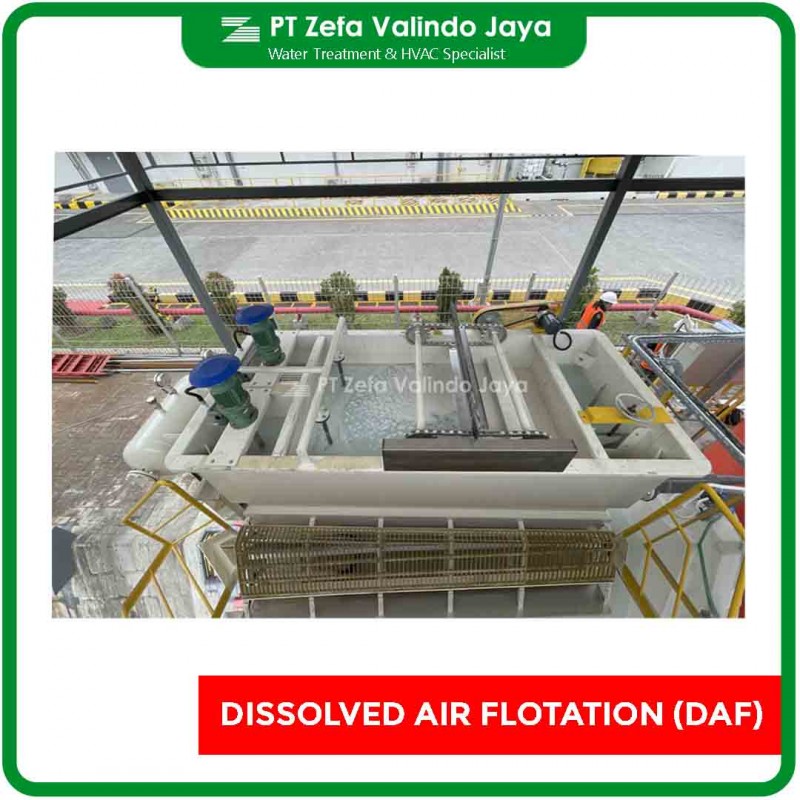


Dissolved Air Flotation (DAF)
DAF
New product
PLEASE FILL OUT THE SURVEY FORM HERE
Price : Based on processing capacity, water source, processing target
Data : By survey form
More info
PLEASE FILL OUT THE SURVEY FORM HERE
Price : Based on processing capacity, water source, processing target
Data : By survey form
WASTEWATER TREATMENT SOLUTION FOR REDUCING OIL, GREASE, AND SUSPENDED SOLIDS
Wastewater containing oil, grease, suspended solids (TSS), and other contaminants often requires an effective separation process before entering the next treatment stage.
Dissolved Air Flotation (DAF) is a wastewater treatment technology that uses very fine air bubbles to lift and separate contaminants from water.
WHAT IS DISSOLVED AIR FLOTATION (DAF)?
Dissolved Air Flotation (DAF) is a wastewater treatment process used to separate suspended solids, oil, grease, and low-density contaminants from water using microscopic air bubbles.
In a DAF system, a portion of the treated water is recirculated and pressurized. Air is then dissolved into the pressurized water.
When the pressurized water is released into the flotation tank, the dissolved air forms very fine air bubbles. These bubbles attach to solid particles, oil, and grease, causing them to rise to the water surface.
The floating contaminants are then collected and removed as sludge, while the clarified water flows out of the DAF unit.
DISSOLVED AIR FLOTATION (DAF) PROCESS FLOW
Wastewater → Coagulation → Flocculation → Dissolved Air → Flotation → Sludge Separation → Treated Water
ADVANTAGES OF THE DAF SYSTEM
• Effectively reduces oil and grease
• Helps reduce suspended solids (TSS)
• Helps reduce BOD and COD loads
• Effectively separates low-density particles
• Can help reduce the load on biological treatment processes
• Provides relatively fast separation
• Can be combined with coagulation and flocculation processes
• Suitable for various types of industrial wastewater
• Can be designed according to treatment capacity and wastewater characteristics
HOW DOES DAF WORK?
In simple terms, the Dissolved Air Flotation process works as follows:
- Wastewater Enters the System
Wastewater enters the DAF unit after undergoing pretreatment, if required. Screening or other preliminary treatment processes may be used to remove large materials. - Coagulation and Flocculation Process
Chemicals such as coagulants and flocculants can be added to bind and combine small particles into larger flocs. This stage is important for improving separation efficiency, particularly for fine suspended solids and contaminants that are difficult to separate.
- Pressurized Water and Air Dissolution
A portion of the water is recirculated using a recycle pump and pressurized. Air is then introduced and dissolved into the pressurized water. - Formation of Air Bubbles
When the pressurized water is released into the flotation tank, the pressure decreases and the dissolved air comes out of the solution in the form of very fine air bubbles. - Flotation Process
The air bubbles attach to suspended solids, oil, grease, and other contaminants. The particles become lighter and are lifted to the surface of the flotation tank.
- Sludge Collection and Removal
The sludge floating on the surface is collected using a sludge scraper or skimming mechanism and transferred to the sludge collection chamber. - Treated Water Exits the DAF
After the contaminants are separated, the treated water exits the DAF unit and proceeds to the next treatment stage according to the WWTP design.
MAIN COMPONENTS OF DISSOLVED AIR FLOTATION (DAF)
A DAF system consists of several main components that work together to achieve an effective separation process.
- DAF Flotation Tank
The main tank where the flotation and separation of contaminants from wastewater take place. - Air Saturation System
A system used to dissolve air into the recycled water at a specific pressure. - Recycle Pump
A pump used to recirculate and pressurize a portion of the water for the dissolved air flotation process. - Air Compressor
Provides the compressed air required for the air dissolution process. - Chemical Dosing System
Used to inject coagulants, flocculants, pH adjustment chemicals, or other chemicals according to the wastewater characteristics. - Sludge Scraper
A mechanism used to collect sludge floating on the surface of the flotation tank. - Sludge Collection Chamber
A section used to collect the separated sludge before it is transferred to the next treatment or dewatering process. - Control Panel
A control panel used to operate and control the pumps, air system, chemical dosing system, and other components.
DISSOLVED AIR FLOTATION (DAF) APPLICATIONS
DAF is widely used in industries that generate wastewater containing oil, grease, suspended solids, and other contaminants.
Some common DAF applications include:
• Food and beverage industries
• Vegetable oil processing industries
• Palm oil industries
• Meat and poultry processing industries
• Dairy and milk processing industries
• Fish and seafood processing industries
• Oil and petrochemical industries
• Textile industries
• Chemical industries
• Pharmaceutical industries
• Manufacturing industries
• Wastewater treatment with high oil and grease content
DAF VS. CONVENTIONAL SEDIMENTATION
DAF and sedimentation are both used for solid-liquid separation, but they use different separation mechanisms.
Sedimentation uses gravity to allow particles with a higher density than water to settle at the bottom of the tank.
DAF, on the other hand, uses microscopic air bubbles to make contaminants float to the surface, where they can be collected and removed from the system.
DAF is particularly suitable for wastewater containing oil, grease, low-density particles, emulsified contaminants, and fine suspended solids that are difficult to separate using conventional sedimentation.
DISSOLVED AIR FLOTATION (DAF) PRICE
Every type of wastewater has different characteristics. Therefore, the selection of a DAF system cannot be based solely on flow rate.
Several parameters need to be considered, including:
• Wastewater flow rate
• TSS concentration
• Oil and grease concentration
• BOD and COD levels
• Wastewater pH
• Wastewater temperature
• Type and concentration of contaminants
• Treatment efficiency targets
• Chemical requirements
• Available installation area
NEED A DAF SOLUTION FOR YOUR WASTEWATER?
High levels of oil, grease, TSS, or suspended solids can interfere with the wastewater treatment process and increase the load on subsequent treatment stages.
With a properly designed DAF system, contaminant separation can be carried out more effectively, helping improve the overall performance of the wastewater treatment system.
Consult with us about your DAF requirements, and we will help determine the appropriate DAF capacity and specifications based on your wastewater characteristics.
Contact PT Zefa Valindo Jaya for consultation and a DAF system quotation.