

No products
Prices are tax excluded


More info
Chemical Dosing System for Water Treatment, Wastewater Treatment, Boilers, Cooling Towers, and Swimming Pools
In water and wastewater treatment systems, chemicals must be dosed accurately to ensure efficient and reliable treatment performance. One of the most important pieces of equipment used for this purpose is a Chemical Dosing System.
A dosing system is designed to inject chemicals into water or process streams automatically or semi-automatically at precise dosing rates. It is widely used in Water Treatment Plants (WTP), Wastewater Treatment Plants (WWTP), Sewage Treatment Plants (STP), boilers, cooling towers, swimming pools, and various industrial processes.
By using a dosing system, chemical consumption can be accurately controlled, improving process efficiency while minimizing chemical waste and operating costs.
What is a Dosing System?
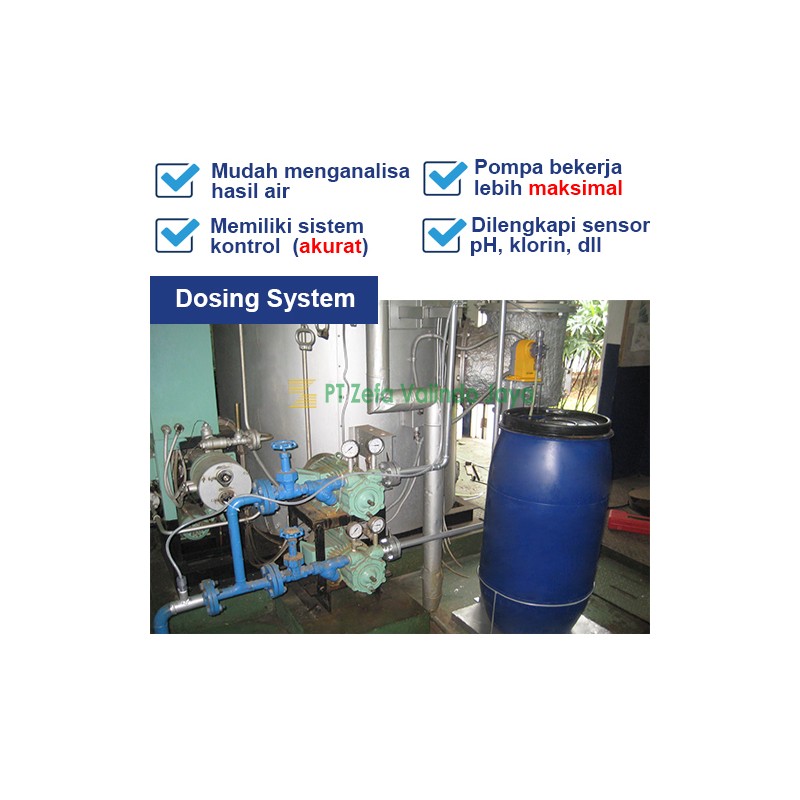
A Dosing System is an integrated chemical injection system consisting of a chemical storage tank, dosing pump, piping, valves, injector, and control panel. Its primary function is to inject chemicals into a process at a controlled flow rate and dosage.
A dosing system can be used for a wide variety of chemicals, including:
-
PAC (Polyaluminum Chloride)
-
Polymers
-
Antiscalants
-
Corrosion Inhibitors
-
Oxygen Scavengers
-
Acids and Alkalis
Each application requires a different chemical dosage; therefore, the dosing pump capacity should be selected according to the system requirements.
Components of a Dosing System
A complete dosing system package typically consists of the following components.
1. Chemical Tank
A storage tank used to hold chemicals before they are injected into the treatment system.
2. Dosing Pump
The dosing pump is the core component responsible for injecting chemicals at an adjustable flow rate according to process requirements.
3. Agitator (Optional)
Used to continuously mix chemical solutions to maintain homogeneity, especially for powdered chemicals such as polymers.
4. Injection Valve
Safely injects chemicals into pipelines or process tanks while preventing backflow.
5. Foot Valve & Strainer
Filters debris from the chemical tank and helps maintain stable suction for the dosing pump.
6. Level Switch (Optional)
Monitors the chemical level inside the tank and automatically stops the pump when the tank is empty, protecting the pump from dry running.
7. Control Panel
Controls the operation of the dosing pump in either manual or automatic mode.
Benefits of Using a Dosing System
A chemical dosing system offers numerous advantages, including:
-
Accurate chemical dosing
-
Reduced chemical consumption and waste
-
Automated operation
-
Improved treatment efficiency
-
Reduced errors associated with manual dosing
-
Easy operation
-
Low maintenance requirements
-
Customizable for various treatment capacities
-
Improved operator safety by minimizing direct contact with chemicals
Common Dosing Pump Brands Used in Dosing Systems
Selecting the right dosing pump depends on the chemical properties, dosing capacity, operating pressure, and required accuracy. PT Zefa Valindo Jaya supplies various dosing pump brands to meet different industrial applications.
Milton Roy is a premium industrial dosing pump designed for high-pressure applications requiring exceptional dosing accuracy. It is widely used in large industrial facilities and municipal water treatment plants. Typical Applications: Wastewater Treatment Plants (WWTP), Chemical Industry, Oil & Gas, Power Plants, High-Pressure Boiler Systems, Petrochemical Industry
ProMinent is a leading German manufacturer of premium dosing pumps and chemical dosing systems. In addition to dosing pumps, ProMinent offers advanced monitoring and automatic chemical control. solutions. Typical Applications: Pharmaceutical Industry, Food & Beverage, Water Treatment, WWTP, Cooling Towers, Chemical Processing
Tacmina is a Japanese dosing pump manufacturer known for its innovative Smoothflow Pump Technology, which provides extremely stable chemical flow with minimal pulsation. It is widely used in applications requiring highly accurate dosing. Typical Applications: Electronics Industry, Pharmaceutical Industry, Food & Beverage, Boiler Water Treatment, Precision Chemical Dosing, Water Treatment Plants
Ailipu dosing pumps are widely used in water and wastewater treatment due to their reliable performance and competitive pricing. The product range includes both solenoid diaphragm and motor-driven diaphragm dosing pumps. Typical Applications: Water Treatment Plants (WTP), Wastewater Treatment Plants (WWTP), Sewage Treatment Plants (STP), Cooling Towers, Boiler Water Treatment, Manufacturing Industry
Grundfos is one of the world's leading dosing pump manufacturers, widely recognized for its precision, reliability, and ease of operation. Its dosing pumps are extensively used across water treatment and industrial applications. Typical Applications: Water Treatment Plants (WTP), Boiler Water Treatment, Cooling Towers, Reverse Osmosis (RO) Systems, Swimming Pools, Industrial Chemical Dosing.
Types of Dosing Pumps Based on Operating Principle
Solenoid Diaphragm Dosing Pump
Suitable for low to medium flow rates and low to medium operating pressures.
Motor-Driven Diaphragm Dosing Pump
Designed for higher dosing capacities and industrial applications.
Plunger Dosing Pump
Capable of handling high-pressure applications, making it ideal for boilers, power plants, and industrial process systems.
Hydraulic Diaphragm Dosing Pump
Provides high dosing accuracy and enhanced safety when handling corrosive or hazardous chemicals.
Peristaltic Dosing Pump
Ideal for pumping liquids containing solids, slurry, or chemicals that are sensitive to contamination.
How to Choose the Right Dosing Pump
Choosing the right dosing pump involves more than selecting a brand. The following factors should be considered:
-
Type of chemical being dosed
-
Required dosing capacity (L/h)
-
Operating pressure (bar)
-
Required dosing accuracy
-
Wetted material compatibility (PVC, PVDF, PTFE, SS316, etc.)
-
Control system (manual, analog, digital, or automatic)
-
Installation environment
-
Integration with flow meters, pH meters, conductivity meters, ORP meters, or PLC systems
Our engineering team at PT Zefa Valindo Jaya is ready to help you select the most suitable dosing pump and chemical dosing system based on your specific application requirements.