Anionic Flocculant or Cationic Flocculant? Which one to choose?
Anionic vs. Cationic Flocculants: Which One Should You Choose? Definition, Functions, and Applications
In wastewater treatment, selecting the right flocculant is both a technical and purchasing decision. It directly affects water quality, dewatering unit performance, chemical consumption, and operating costs. The two most commonly used flocculant groups are anionic and cationic flocculants.
A common question is: which should be selected, anionic or cationic flocculant? The answer cannot be determined solely by the industry or equipment being used. Selection should consider particle characteristics, sludge type, surface charge, solids content, chemicals used previously, pH, and the process target. SUEZ technical guidance summarizes the general tendency that cationic flocculants are usually suitable for organic sludge, while mineral sludge generally requires anionic flocculants.
However, this general tendency is not a substitute for testing. The selected product should be the one proven to deliver the best performance on the actual wastewater.
What Is a Flocculant?
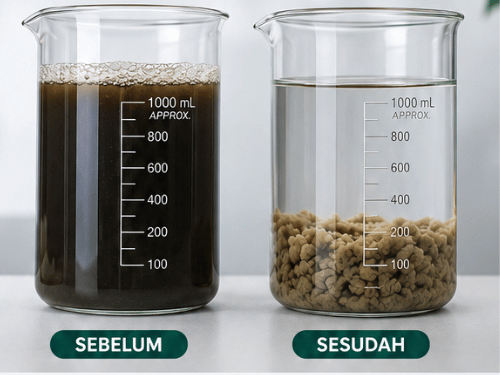
A flocculant is a chemical that helps combine small particles dispersed in water into larger aggregates or clumps called flocs. These flocs are then easier to settle, filter, or separate from the water.
Flocculants are widely used in wastewater treatment, sludge thickening, water clarification, and dewatering, which is the process of reducing the water content of sludge.
Differences Between Anionic and Cationic Flocculants
The main difference between the two lies in their electrical charge.
Cationic flocculants carry a positive charge. They are often used to help bind biological sludge particles, which tend to carry a negative charge.
Anionic flocculants carry a negative charge. They are often used to assist the settling of mineral, soil, sand, and other inorganic particles.
This classification is only a starting point. The best results still depend on the characteristics of the wastewater being treated.
When Should Anionic Flocculants Be Used?
Anionic flocculants are generally considered for water or sludge containing significant amounts of mineral and inorganic particles.
Examples of applications include:
- Raw water treatment.
- Mining and mineral processing.
- Sand and aggregate washing.
- Ceramic manufacturing.
- Concrete manufacturing.
- Stone or marble cutting.
- Metal industries.
- Sludge containing significant amounts of soil, sand, silica, or minerals.
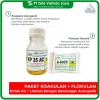
One product that can be used is AQUARIGHT A 6025 Anionic Flocculant, a medium-molecular-weight anionic flocculant suitable for sludge dewatering or thickening, wastewater clarification, and solid-liquid separation.
AQUARIGHT A6025 Anionic Flocculant

AQUARIGHT A6025 is an anionic flocculant, or a negatively charged polymer, that helps bind small particles in water or sludge. This allows suspended solids to settle more quickly and produces clearer water.
Anionic flocculants are commonly used in solid-liquid separation processes, including dewatering and water clarification. AQUARIGHT A 6025 is particularly suitable for non-organic substrates, such as sand and mining applications, pulp and paper, domestic wastewater or STP (Sewage Treatment Plant) applications, clean water treatment or WTP (Water Treatment Plant) applications, sludge dewatering treatment, GRC board production, asbestos-cement board production, and other similar applications.
AQUARIGHT A 6025 Anionic Flocculant Specifications
A6025 anionic flocculant is available in powder and ready-to-use liquid forms.
Powder Flocculant Specifications
- Appearance: White granular powder
- Bulk density: Approximately 0.7–0.8
- Water solubility: Completely soluble, but dissolves very slowly
- pH (1%): 6.0–8.0
Liquid Flocculant Specifications
- Appearance: Clear
- Specific gravity (g/mL): 0.98–1.00
- pH (0.1%): 6.0–8.0
When Should Cationic Flocculants Be Used?
Cationic flocculants are generally considered for sludge generated by biological processes or containing a high proportion of organic matter.
Examples of applications include:
- Food and beverage industries.
- Dairy and meat industries.
- Slaughterhouses.
- Palm oil mills.
- Pulp and paper industries.
- Textile industries with biological treatment processes.
- Pharmaceutical and cosmetic industries.
- Domestic and municipal wastewater treatment.
- Sludge from waste activated sludge and biological sludge processes.
One product that can be used is AQUARIGHT C6660 Cationic Flocculant, a medium-molecular-weight cationic flocculant suitable for sludge dewatering or thickening, wastewater clarification, and solid-liquid separation.
AQUARIGHT C6660 Cationic Flocculant

AQUARIGHT C6660 is a medium-molecular-weight cationic flocculant formulated to improve wastewater treatment performance through effective sludge conditioning and solid-liquid separation. The product is widely used to improve sludge dewatering efficiency while helping produce clearer treated water in various industrial and domestic wastewater treatment applications.
AQUARIGHT C 6660 Cationic Flocculant Specifications
- Appearance: White crystalline powder
- Relative density to water (=1): 1.302
- Solubility: Soluble in water
So, Should You Choose an Anionic or Cationic Flocculant?
As a simple guide:
- Choose a cationic flocculant as the initial candidate if the sludge comes from a biological process or contains a high proportion of organic matter.
- Choose an anionic flocculant as the initial candidate if the sludge contains significant amounts of minerals, soil, sand, or inorganic solids.
- Test both types if the wastewater comes from a mixed process or its characteristics are not yet known.
The selection cannot be determined solely by industry type. Two companies in the same industry may require different flocculants because their wastewater characteristics are not necessarily the same.
In addition to the flocculant type, process results are also affected by solids content, pH, previously used chemicals, dewatering equipment, and flocculant dosage.
Why Is a Jar Test Necessary?
A jar test is a simple test used to compare several types and dosages of flocculants using a sample of the wastewater to be treated.
A jar test can help determine:
- Which flocculant forms the best flocs.
- Which flocs settle more quickly.
- How clear the water becomes after settling.
- The most effective dosage.
- Which product delivers the best results with efficient chemical use.
Flocculant selection should therefore be adjusted to the characteristics of the wastewater. To determine the most suitable type and dosage, conduct a jar test or a direct process trial before selecting a product for routine use.